Meal Planning
Preparing the Week: Notes on a Practical Kitchen Routine
How a structured approach to weekly preparation reshapes the way nutritional goals translate into actual meals.
There is a quiet intelligence embedded in a kitchen that follows the calendar. The turnip that arrives in October carries a density the July courgette will never match; the spring spinach, young and lightly mineral, requires nothing more than a warm pan and a moment of attention. To eat with the seasons is not a directive for austerity — it is a way of reading the year through the produce it offers, and of building meals that hold together because their ingredients were always destined to coexist.
The concept of seasonal cooking often becomes entangled with virtue — a shorthand for buying from a farmers market rather than a supermarket, or choosing organic over conventional. These distinctions matter in some contexts, but they obscure the more fundamental relationship between growing conditions and nutritional composition. Produce harvested at the peak of its season contains a different profile of vitamins, minerals, and phytonutrients than the same crop harvested early and cold-stored for months.
A British winter squash, for instance, develops its full complement of carotenoids — the plant pigments responsible for its deep orange flesh — only when it has had sufficient sun exposure and time on the vine. Picked early and ripened off the plant, it looks approximately the same but delivers a measurably different experience. This is not an argument against supermarkets. It is an argument for understanding what you are choosing and why.
The fibre-rich diet that nutritional guidance consistently points toward is most easily assembled from vegetables in their prime. Fibre content, too, varies with maturity and storage conditions. Young leeks, parsnips left in the ground until January frost has sweetened them, and January King cabbages that have endured the cold — these carry structural plant matter that supports healthy digestive function in a way that pre-cut, long-stored equivalents often cannot replicate.

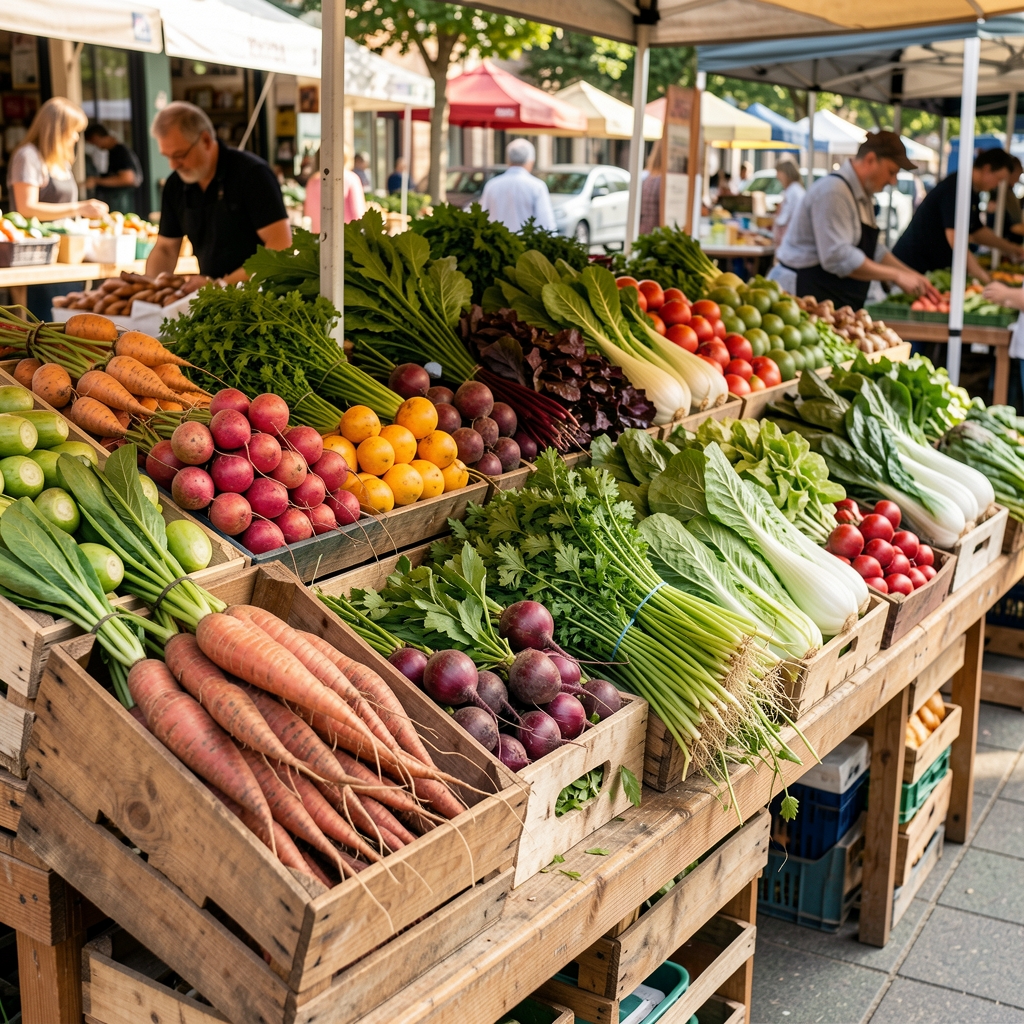
Winter root vegetables, harvested at full maturity. London, January 2026.
The question of balanced meals is often framed as a problem of proportion — how much protein, how much carbohydrate, how much fat. While these proportions are meaningful, they can become an abstraction that floats free of the actual food on the table. The most useful place to anchor a conversation about balance is in the concrete reality of what is growing now, what is affordable now, and what can be prepared without advanced technical skill.
A winter plate centred on roasted celeriac, braised lentils, and a handful of watercress achieves something that a macro-counter might recognise as excellent: substantial fibre from both the vegetable and the legume, a meaningful protein contribution from the lentils, and a peppery green that brings iron, vitamin C, and a textural contrast that makes the dish worth eating again. The balance emerges from the ingredients themselves, not from calculating backwards from a target.
Portion awareness does not require weighing food at every meal. It requires familiarity — with what a satisfying serving of grains looks like in a particular bowl, with how much protein a palm-sized piece of fish represents, with the difference between eating slowly and eating fast. Seasonal cooking tends to slow the meal down simply because its ingredients carry more flavour and require less supplementation.
"The balance emerges from the ingredients themselves, not from calculating backwards from a target."
Whole foods — a category that includes unprocessed or minimally processed grains, legumes, vegetables, fruits, nuts, seeds, and quality animal products — form the foundation of most dietary guidance issued by nutritionist guidance bodies in the UK and beyond. The language around them can feel abstract, but the operational principle is simple: the closer a food is to its original form when it reaches the plate, the less of its nutritional architecture has been dismantled in processing.
Seasonal cooking is, almost by definition, whole-food cooking. A leek from a November allotment is not a leek that has been processed, fortified, or reformulated. It is a leek. The meal-planning discipline required to make use of seasonal produce — buying in quantities that can actually be used, preparing in advance, using stems as well as leaves — is the same discipline that builds a sustainable relationship with home-cooked meals over the long term.
Gut-friendly recipes that appear frequently in contemporary nutrition writing — fermented vegetables, pulse-rich stews, diverse salad compositions — draw naturally on whatever is seasonal because seasonal produce offers the diversity of plant species that current research on digestive health consistently recommends. Rotating the vegetables on your plate according to season, rather than eating the same four varieties year-round, is one of the most accessible ways to extend that diversity without significant additional cost or effort.
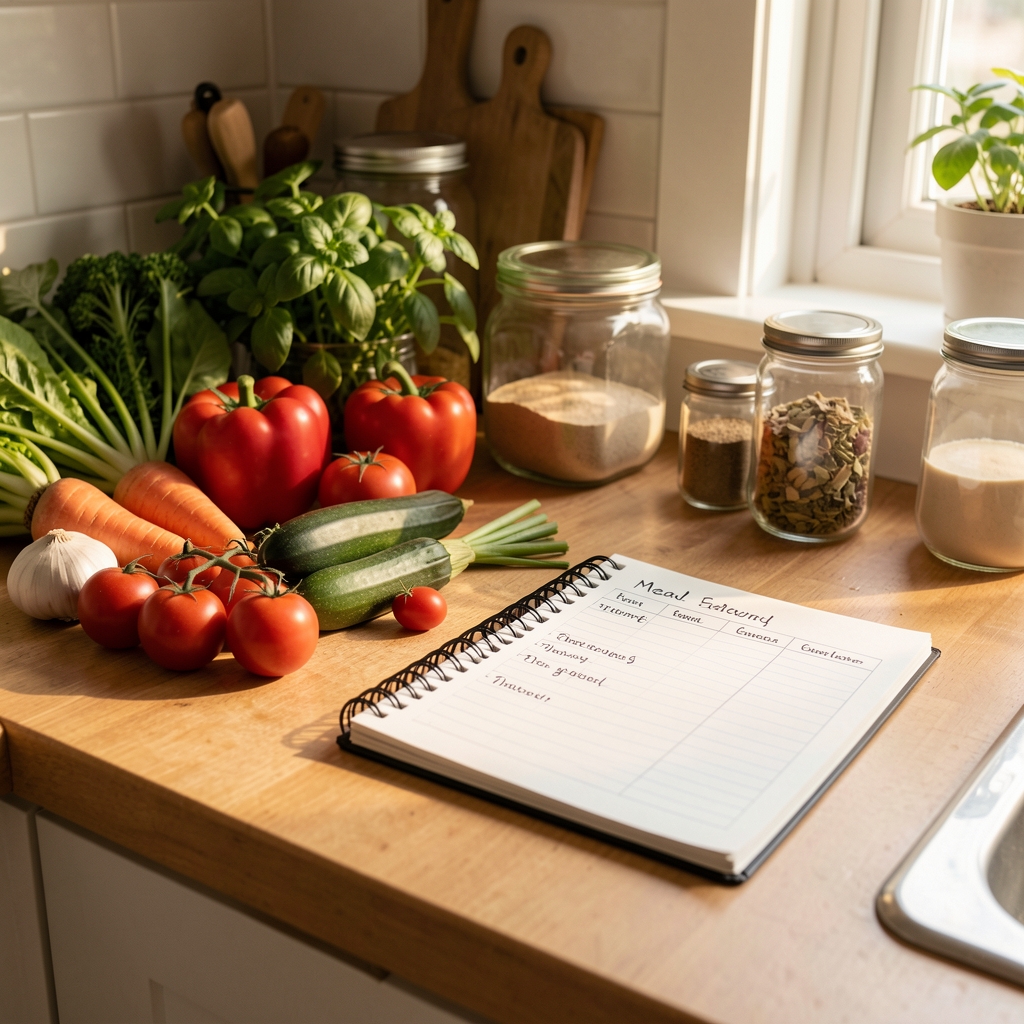
Meal planning, in its most useful form, is not a spreadsheet exercise. It is a light framework that reduces the number of decisions required at the end of a long day. When the framework is anchored to seasonal availability rather than fixed recipes, it becomes flexible in a way that rigid planning rarely achieves. A plan built around a weekly grocery acquisition — half a head of red cabbage, a bunch of chard, a bag of chestnuts in November — can generate a week of varied meals without requiring a new recipe for every evening.
The food journal, used by many as a tool for calorie awareness, can serve an equally useful function as a record of what vegetables appeared in meals across a month. Patterns emerge quickly: the same two or three varieties, used in the same two or three ways, repeated until the season changes without anyone noticing. This kind of self-observation is what nutritionist guidance means when it recommends variety — not variety in the abstract, but variety made visible by keeping simple records.
Hydration habits are rarely discussed in relation to seasonal eating, but they are not disconnected. Autumn and winter vegetables — squash, celeriac, swede — carry significant water content, as do the broths and soups they naturally generate. A diet built largely around home-cooked meals with substantial vegetable components provides a portion of daily fluid intake that is often overlooked when hydration is considered only in terms of water drunk directly.
Weight management conversations tend to collapse quickly into mathematics — energy in, energy out — in a way that misses what actually drives sustainable change. The evidence on sustainable weight approach consistently points toward dietary patterns rather than individual foods or isolated interventions. A pattern centred on seasonal vegetables, adequate protein, regular home-cooked meals, and measured portion control creates the conditions for gradual, self-sustaining progress in a way that short-term restrictive approaches rarely achieve.
Calorie awareness, used gently and without obsession, can be a useful orientation tool — particularly for readers who have never paid attention to the relative energy densities of different foods. A bowl of roasted parsnips and a bowl of fried potatoes may look similar at the table but differ substantially. Understanding this without being governed by it is the balance that most qualified nutrition professionals describe as the goal.
The active lifestyle that supports weight management and general wellbeing is easier to sustain when the diet that accompanies it is satisfying and varied. Sport and fitness have different energy demands depending on frequency and intensity, and the seasonal plate — dense in winter, lighter in summer — often tracks naturally with the changing demands of outdoor activity across the British year.

Eleanor Whitfield is a senior contributing writer at Talera Review, where she covers everyday nutrition, seasonal food culture, and the intersection of dietary habit and active living. Her work draws on published dietary research and extended conversations with practising nutrition professionals across the UK.
More from Eleanor Whitfield →
How a structured approach to weekly preparation reshapes the way nutritional goals translate into actual meals.

An editorial reflection on how daily movement and dietary rhythm influence each other across a week of ordinary life.