
Seasonal Cooking
Seasonal Vegetables and the Rhythm of a Balanced Plate
A considered look at how seasonal vegetables shape the nutritional quality of everyday meals and the balanced plate.

There is a tendency in nutritional writing to treat food and movement as two separate variables in a weight management equation — energy consumed on one side, energy expended on the other. This framing is not wrong in its arithmetic, but it misses something important about how the relationship actually functions in the daily life of a person who is neither an elite athlete nor a sedentary office worker, but something in between. Most of us occupy that middle ground, and the interaction between what we eat and how we move across a week is more textured and reciprocal than a simple equation suggests.
The relationship between physical activity and appetite regulation is one of the more interesting and counter-intuitive areas of nutrition research. Moderate-intensity movement — a brisk forty-minute walk, a bicycle commute, a lunchtime swim — tends to attenuate acute hunger signals in the period immediately following the activity. This is partly the result of the body's prioritisation of circulatory demands during sustained movement and partly the effect of shifts in the signals that govern hunger perception.
What this means practically is that people who move regularly throughout the week often report that their eating rhythm aligns itself more naturally with genuine hunger rather than with the habitual triggers — the clock, the anxiety, the screen break — that drive so much incidental eating. The connection is not supported and varies considerably between individuals, but it is consistent enough in the published research to be worth noting as a reason why an active lifestyle and mindful eating tend to reinforce each other rather than operating in parallel.
High-intensity activity of longer duration behaves differently. Extended sport sessions — a two-hour cycling ride, a competitive match, a long trail run — significantly increase acute energy demand and can generate appetite responses that persist well beyond the activity itself. Eating in response to genuine post-activity energy need is not overeating. Understanding the difference between the genuine need and the habitual over-compensation that can follow intense exercise is one of the places where nutritionist guidance becomes practically useful.
The dietary pattern associated with sustained physical activity and general wellbeing in published research is consistent across multiple populations and study designs. It centres on adequate carbohydrate intake — primarily from whole grain sources — to supply the glycogen that working muscles require; sufficient protein to support the repair and renewal of muscle tissue following activity; and a substantial vegetable and fruit component that provides the micronutrients and fibre that support both digestive function and general energy metabolism.
The emphasis on protein in popular fitness culture has been sufficiently strong for long enough that many active people consume more than they need while paying less attention to the carbohydrate and fibre components of their diet. The protein-to-fibre ratio on the plate of a typical gym-going adult in the UK skews significantly toward protein, often at the expense of the diverse plant composition that supports digestive health and provides the micronutrients that support energy production at the cellular level.
Whole foods provide a more complete nutritional package than protein supplements precisely because they arrive with fibre, vitamins, minerals, and secondary plant compounds that isolated protein sources do not contain. This is not an argument against protein supplementation in contexts where it is genuinely useful — for athletes in structured training blocks, for older adults with reduced dietary variety, or for those with limited access to protein-rich whole foods. It is an argument for not treating protein as the single variable that matters.
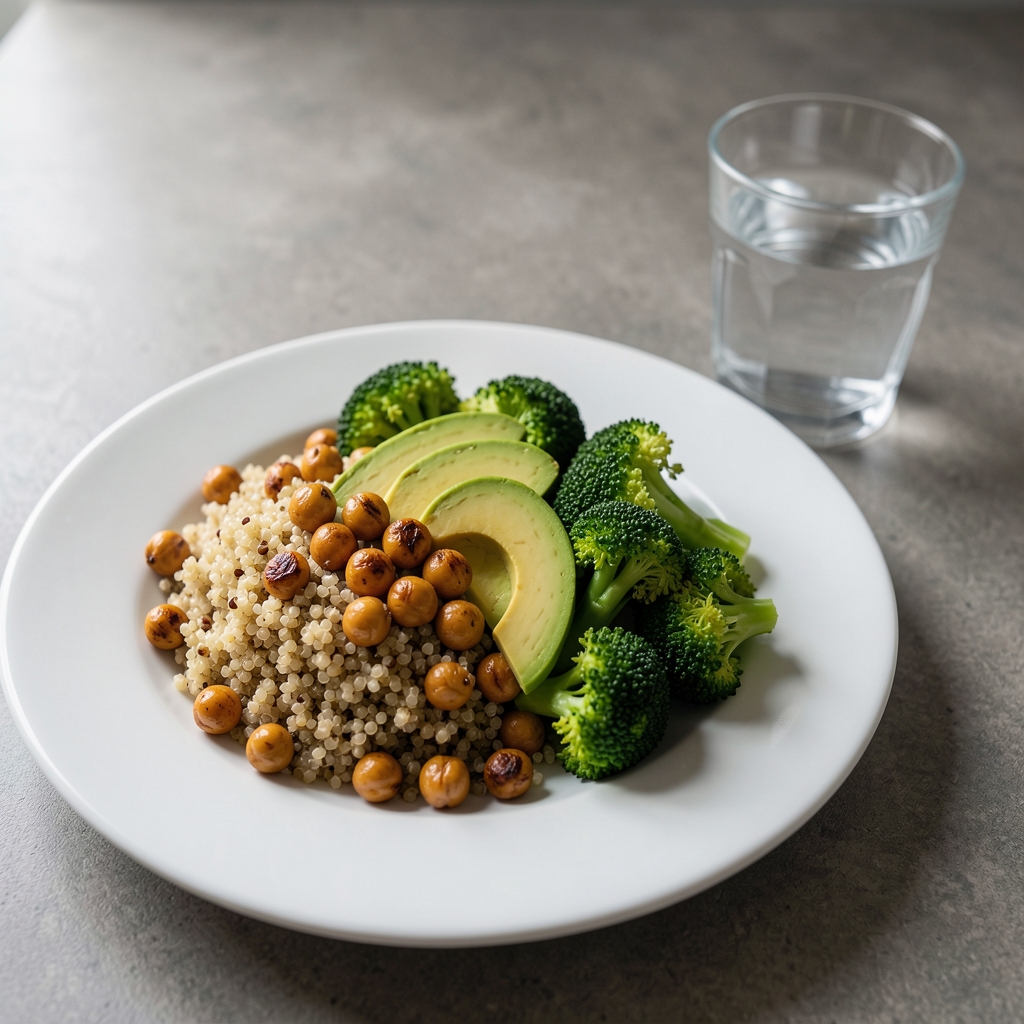
A whole-food meal assembled after an active morning. London, March 2026.
Hydration habits are closely linked to both physical performance and dietary quality in ways that are often discussed separately. An adequately hydrated person makes different food choices from a mildly under-hydrated one: the confusion of thirst signals with hunger signals is well-documented and accounts for a meaningful portion of incidental food consumption, particularly in the afternoon hours when fluid intake tends to fall and discretionary snacking tends to rise.
Movement accelerates fluid loss through perspiration and respiration, which increases the baseline fluid requirement on active days. The practical implication is simple but worth stating: on days when activity is planned, the fluid needs of the body are higher and the window in which mild dehydration can affect food choices is wider. Establishing a consistent hydration pattern — a glass of water at each meal, a bottle carried through an active commute, attention to the colour of urine as a simple indicator — reduces this variable without requiring any sophisticated monitoring.
"The interaction between what we eat and how we move across a week is more textured and reciprocal than a simple equation suggests."
The sustainable weight approach that most nutritionists and registered dietitians now describe as the target for long-term change has a consistent character: gradual, pattern-based, without dramatic restriction, and supported by a level of physical activity that is genuinely sustainable across the months and years required for the changes to consolidate. Weight management is not an event with a defined end point. It is a configuration of habits that either holds or does not hold depending on how sustainable it is to live within.
Body composition — the ratio of lean mass to fat mass — is influenced by both dietary quality and the type of activity practised. Resistance-based activity, including bodyweight exercises, swimming, and resistance training, preserves and builds lean mass in a way that cardiovascular exercise alone does not. A diet adequate in protein supports this process. Neither the dietary component nor the activity component is sufficient without the other — which is exactly why the question of how they connect in everyday life is worth more than a brief mention in a fitness plan.
The practical implication is that meal planning for an active person should account for variation in energy demand across the week rather than applying a uniform daily intake target. A day with two hours of sport requires more fuel than a rest day. The seasonal plate described elsewhere in this publication also tracks naturally with seasonal activity variation: lighter meals in summer when activity is often higher and meals are taken later; more substantial, carbohydrate-centred meals in winter when the body conserves warmth and activity patterns change.
What does this look like in practice? A week in which someone walks to work three days, attends a yoga session twice, and cycles to the weekend market covers a moderate but meaningful range of physical activity. The dietary needs of that week are not dramatically different from a sedentary week in terms of total energy, but they are different in distribution: more carbohydrate on walking and cycling days, more protein across the week to support the yoga-related muscle engagement, and consistent fibre intake throughout.
The home-cooked meals that constitute the core of the week's eating — the grain bowls, the pulse-based soups, the quickly assembled evening salads — provide this nutritional distribution naturally when they are composed of varied whole foods. The adjustment required between an active day and a rest day is not a change in the character of the food but a modest change in the portion of the energy-dense components: more grain, slightly less on a quiet Tuesday.
Calorie awareness, in this context, means understanding that the body's energy requirements are not fixed across the week and that a rigid daily target applied without regard to activity variation will either over-fuel on rest days or under-fuel on active ones. The capacity to read one's own body and adjust accordingly — to eat more when genuinely hungry after a long walk, to eat less when the day has been still — is the practical expression of what all the nutritional frameworks are pointing toward: an attentive, considered relationship with food that holds across a year and a life.

Tobias Linwood is a contributing writer with a background in sports nutrition research and everyday dietary behaviour. He writes for Talera Review on the intersection of physical activity, eating patterns, and long-term wellness practice. His work has appeared in several UK health and lifestyle publications.
More from Talera Review →
A considered look at how seasonal vegetables shape the nutritional quality of everyday meals and the balanced plate.

How a structured approach to weekly preparation reshapes the way nutritional goals translate into actual meals.